
Exponential#
- class splinebox.basis_functions.Exponential(M)#
Basis function for an exponential spline.
For a detailed theoretical description – including the equation and a plot of the function – refer to the Exponential basis section in the documentation.
The constructor requires M, the number of knots in the spline, as an argument.
Methods
__call__(t[, derivative])Evaluate the function at position(s) t.
Returns a filtered version of the input s, used to convert knots into control points for a closed spline.
Returns a filtered version of the input s, used to convert knots into control points for an open spline.
TODO: This fails the tests.
Examples
>>> import splinebox
>>> import numpy as np
>>> import matplotlib.pyplot as plt
Create a basis function object:
>>> basis_function = splinebox.basis_functions.Exponential(M=5)
Evaluate the basis function at a single position:
>>> basis_function(0.5)
0.5
Evaluate the basis function at multiple positions simultaneously:
>>> t = np.array([-0.2, 0, 0.5])
>>> basis_function(t)
array([0.687, 0.724, 0.5  ])
Compute the first derivative of the basis function at multiple positions:
>>> basis_function(t, derivative=1)
array([ 0.366,  0.   , -0.865])
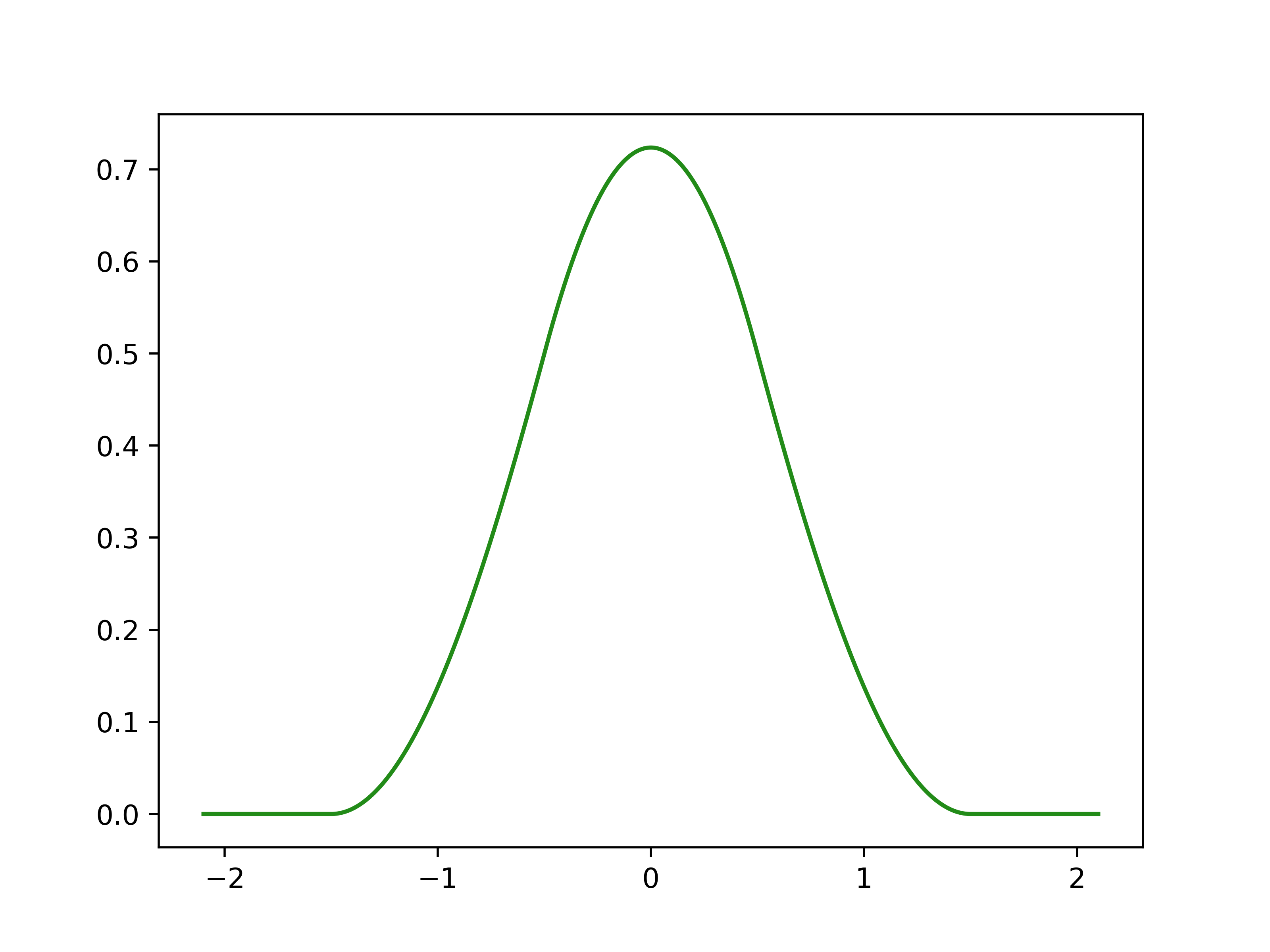
>>> t = np.linspace(-2.1, 2.1, 500)
>>> plt.plot(t, basis_function(t))
>>> plt.show()